****Please
note that NO REPUTABLE BREEDER of Rhodesian Ridgebacks would attempt to
breed any of these unusual colors and patterns. They do occasionally
happen and REPUTABLE BREEDERS place them as pets on a spay/neuter
contact. If ANYONE tries to sell you an oddly colored Ridgeback without
informing you that the color is unacceptable in the show ring
&/or
without a spay/neuter agreement - PLEASE do not purchase a puppy from
them! ****
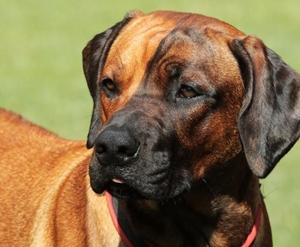
The Ridgeback standard calls for the color
“Wheaten”, but what color
is that?
Wheaten is an old term, commonly used by
terrier people and others
to denote reddish, banded hair where the root is lighter and the tip is
darker. Genetically, this banded hair is called
“agouti” and is considered
the “wild type”. Coyotes, wolves, foxes and
raccoons are just a few animals
that have “agouti” coloring.
Agouti is the gene that makes
a fox have reddish hair with black tips and a coyote to have yellowish
hair with black tips.
Technically, studies show that the agouti protein competes to
bind on
the melanocortin receptor and must sometimes win. The competition is
going
on as the hair is growing and which results in a hair that changes
color
along its length. Little (1957) suggested that agouti is the
gene
that causes paler colors on the underside and dark on the back
– also a
Ridgeback color trait
Occasionally, a Ridgeback is born with a coloration that we
wouldn’t
normally call “agouti” or wheaten. This can be
quite a curiosity and alarming
for breeders – they assume the dogs aren’t
purebred.
Brindle is a pattern of
stripes,which can be red and black,fawn and black, isabella and gray.
It occurs in Great Danes,Greyhounds,Boxers, et al and sometimes
Ridgebacks. The K locus plays a pivotal role in coat color. This locus
is a relative newcomer in our understanding of canine color, and
includes traits formerly attributed by some to other genes.
The dominant allele in the series is KB, which is responsible for
self-coloring, or solid colored fur in pigmented areas. This trait was
formerly attributed to the Agouti (A) locus as AS, but recent breeding
studies had shown this not to be the case.
Any animal with at least one KB allele will be self-colored.Any animal
with at least one kbr allele, and no KB allele will be brindled on
agouti background (see A locus).Any animal with two ky alleles will
show agouti patterns (see A locus).
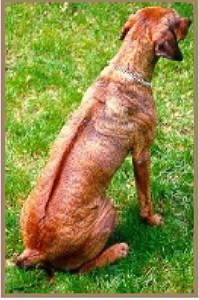
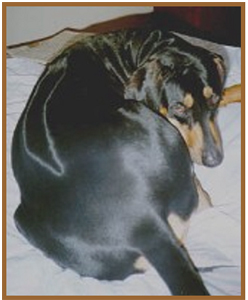
Black & Tan (solid black
coat with tan points) is actually
carried on the “agouti” allele and is a recessive
coloration, that is,
both parents must carry the recessive in order for it to show up in
pups.
Pictured is Shona,
a purebred RR. Look how her ridge appears to be outlined! Very lovely!
To
read more about the Black and Tan genetics, check out this page.
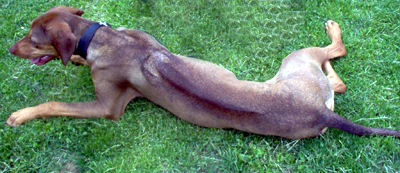
Just as there are
Black andTans, the
recessive of agouti, there is also a
“recessive” of it, resulting in the Rustbody color with Tan points.
Unlike the Black and Tan, who's coloration remained the same as she
aged,
the Rust and Tan's coat has "wheatened out".
Thanks to
Jabulani RRs for this photo.
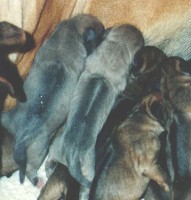
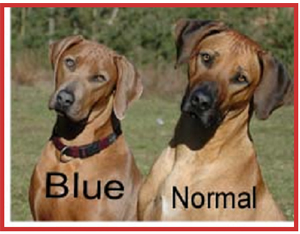
Silver or gray is actually just a
dilution gene acting on the
body color. Puppies are born very silver ( easily recognized in these
newborns) or grayish and have blue eyes.
As they mature, the body color becomes less gray and more the color of
a paper bag. The eyes may stay blue or become amber in color. Thanks to
Kalmara RRs for the photo.
Thanks
to Bonnie van der Born for the photos.
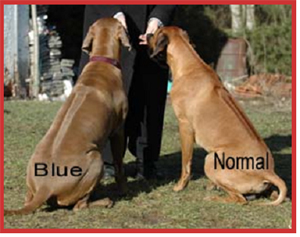
Just
as there are variations in the coat colors of
“normal” RRs, there are also variations in the
“dilutes”. This shows one example of a dilute and
normal colored RR.
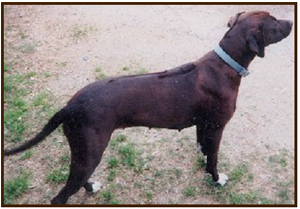
Black wheaten is the rarest of these
colors, however were it
not for an owner’s love, black wheaten RRs might have become
more common
in the US. Back in the 50’s, the owners of a large
kennel in CA went
to Africa to purchase RR stock. While attending a party one night, they
saw a beautifully structured black wheaten dog and tried to purchase it, but the
owner
wouldn’t part with it.
The body appears black, but on closer inspection the
lighter roots show
through in all the usual places – behind the shoulders, on
the side of
the neck and in the britches. Also it peeks through on the undersides
of
the dog and remains dark on top. I hope you can see it in this photo of
a very rare dog – a black wheaten Ridgeback. Thanks to AKC
for the photo.
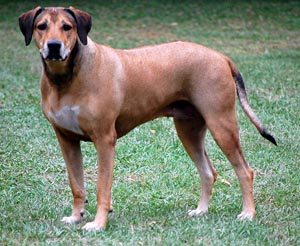
Although acceptable, the following coloration on a dog is not
preferred, due to the grizzled appearance.
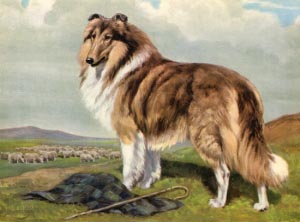
This dog shows it's collie heritage in the body
color.: Note how both this dog and the Collie have a "widow's
peak between the eyes, the darker ears and the
black "ruff" or ring under the neck, also the lighter lower legs and
the darker hairs on the tail. Early RRs
often had white ruffs just like the Collies, but this was discouraged
by minimizing the white in
our standard.BTW, this is an agouti pattern, or wheaten, as the base of
the hair is light and the tip darker - just darker in some areas.
The collie was in the mixture that made up the
Rhodesian Ridgeback during Von Rooyen's era. This breed probably gave
the RR it's superior lion hunting abilities as holding a lion "at bay"
is a herding
behavior. According to some histories, Von Rooyen said the best dog he
ever bred was a Collie -RR mix, because not only would it hunt, it
would go out and herd the livestock as well.
This puppy exhibits a condition known as "mosaic". This is a result of a mutation occurring in the skin cells of the embryo.
This is the same dog as an adult. Notice he has "wheatened" out on the body color, although the mosaic pattern persists.
Thanks to Barbara Turpin for this photo of a client's pup
This pup shows the expression of a full
"Irish spotting " gene pattern.
In Ridgebacks, we try and breed this to a minimum, but sometimes
it comes out. Irish spotting shows in the white legs, tail tip,
undersides, chest, neck and around the neck with white on the muzzle and sometimes a blaze.
Breeds normally exhibiting this coloration would be Collies, Sheltis,
Corgis, Boxers, AmStaffs, Boston Terriers and many others.
There are genetic tests for coat color in Ridgebacks! If you
are interested, go to VetGen
If you have an odd colored Ridgeback, not shown here and can
identify the color ( and hopefully,
tell us about the genetics of it), just
email me at Kalahari
RRs.
Please email me first, BEFORE sending a photo.
***I have no plans to add any other photos of colors already
on this page and I do not collect photos of additional dogs.